
Losing weight doesn’t have to be complicated. If you’ve ever wondered how many calories to lose 1 pound a week, you’re not alone — it’s one of the most searched weight loss questions worldwide. The good news? The answer is rooted in simple, proven science. In this guide, we’ll break down the exact calorie deficit you need, how to calculate it for your body, and practical strategies to hit your goal — sustainably.
Table of Contents
What Is a Calorie Deficit and Why Does It Matter?
Before diving into numbers, it’s important to understand the foundation of weight loss: the calorie deficit.
A calorie deficit occurs when you consume fewer calories than your body burns in a day. Your body then turns to stored fat for energy — and that’s how you lose weight.
There are three ways to create a calorie deficit:
- Eat fewer calories
- Burn more calories through exercise
- Combine both (most effective)
Without a calorie deficit, weight loss simply cannot happen — regardless of what you eat.
How Many Calories to Lose 1 Pound a Week?
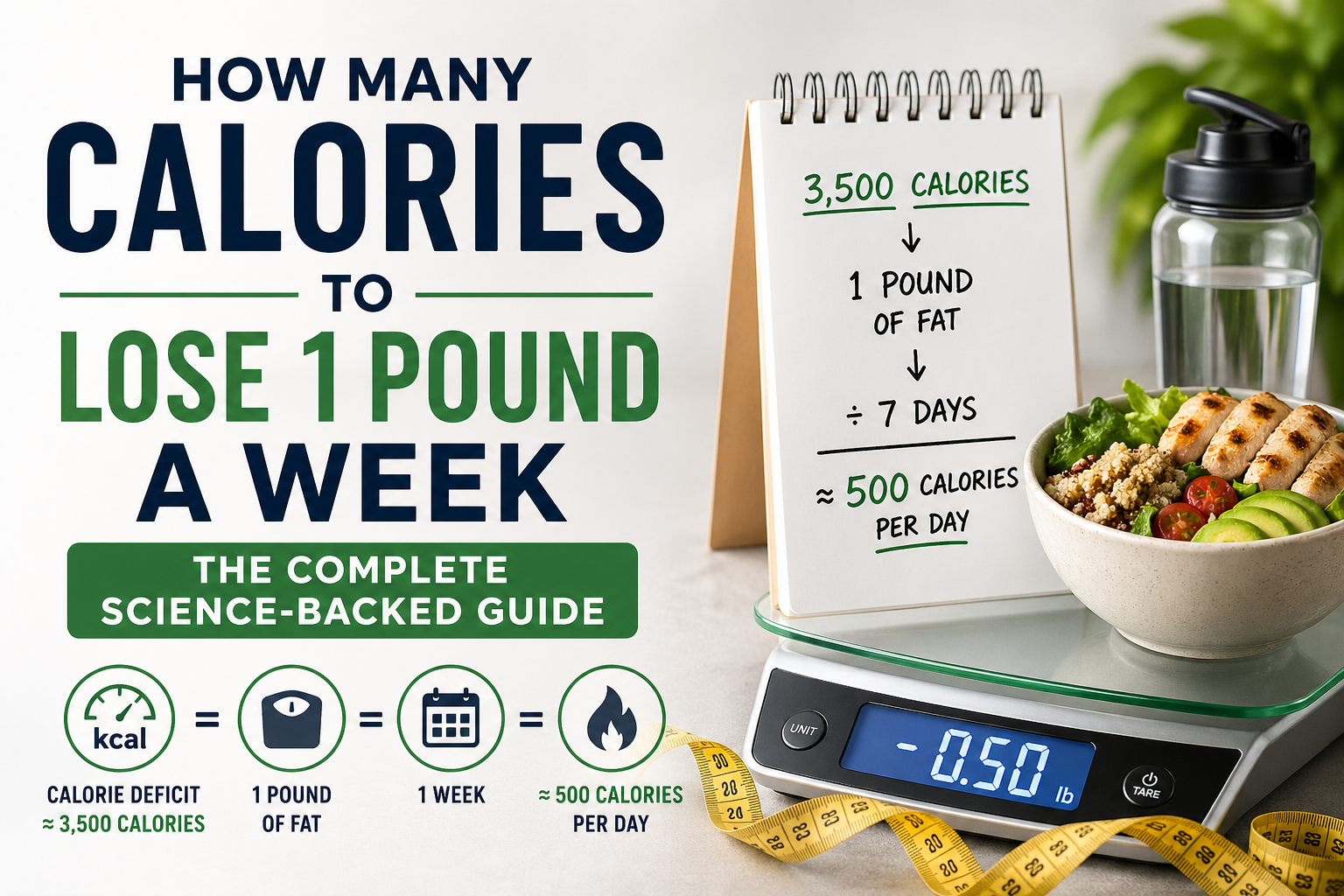
To lose 1 pound per week, you need a daily calorie deficit of approximately 500 calories.
The Science Behind the Number
One pound of body fat contains roughly 3,500 calories equals one pound of fat which is why a consistent daily deficit leads directly to weekly fat loss.
So:
| Goal | Daily Deficit | Weekly Deficit |
|---|---|---|
| Lose 0.5 lb/week | ~250 calories/day | ~1,750 calories |
| Lose 1 lb/week | ~500 calories/day | ~3,500 calories |
| Lose 2 lbs/week | ~1,000 calories/day | ~7,000 calories |
A 500-calorie daily deficit is widely recommended by nutrition experts and dietitians because it’s:
- Achievable without extreme restriction
- Sustainable long-term
- Unlikely to cause muscle loss or nutritional deficiencies
How to Calculate Your Personal Calorie Target
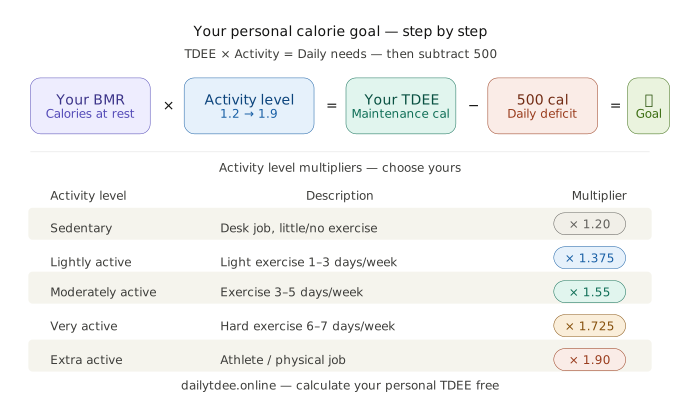
Everyone’s body is different. To find how many calories you should eat to lose 1 pound a week, you first need to know your TDEE (Total Daily Energy Expenditure) — the total calories your body burns each day.
Step 1: Calculate Your BMR (Basal Metabolic Rate)
Your BMR is the number of calories your body burns at rest. “The TDEE calculator formula begins with your BMR using the Mifflin-St Jeor Equation — the gold standard in modern calorie science.”
For Men: BMR = (10 × weight in kg) + (6.25 × height in cm) − (5 × age) + 5
For Women: BMR = (10 × weight in kg) + (6.25 × height in cm) − (5 × age) − 161
Step 2: Multiply by Your Activity Level
| Activity Level | Multiplier |
|---|---|
| Sedentary (desk job, no exercise) | BMR × 1.2 |
| Lightly active (1–3 days/week exercise) | BMR × 1.375 |
| Moderately active (3–5 days/week) | BMR × 1.55 |
| Very active (6–7 days/week hard exercise) | BMR × 1.725 |
| Extra active (athlete, physical job) | BMR × 1.9 |
Step 3: Subtract 500 Calories
Your Weight Loss Calorie Goal = TDEE − 500
Example: A 30-year-old woman, 165 cm, 70 kg, lightly active:
- BMR = (10 × 70) + (6.25 × 165) − (5 × 30) − 161 = 1,476 calories
- TDEE = 1,476 × 1.375 = 2,030 calories/day
- Weight loss goal = 2,030 − 500 = 1,530 calories/day
Is Losing 1 Pound a Week Realistic and Safe?
“Yes — understanding how many calories to lose 1 pound a week is the gold standard approach recommended by health professionals worldwide.”
Health organizations including the CDC recommend losing 0.5 to 2 pounds per week as a safe, sustainable rate. Going faster often leads to:
- Muscle loss instead of fat loss
- Nutritional deficiencies
- Fatigue and hormonal imbalances
- Rebound weight gain (yo-yo dieting)
Slow and steady truly wins the race when it comes to lasting fat loss.
How to Create a 500-Calorie Deficit Daily
You don’t have to starve yourself. Here are practical, proven strategies:
🍽️ Reduce Calories Through Diet (250 calories)
- Swap sugary drinks for water or black coffee
- Use smaller plates to manage portion sizes
- Replace refined carbs (white bread, pasta) with vegetables
- Cut back on ultra-processed snacks and fast food
- Add more protein — it keeps you fuller longer
Easy 250-calorie diet swaps:
- Skip the daily soda → save ~150 calories
- Use 1 tsp butter instead of 3 tsp → save ~60 calories
- Eat an apple instead of chips → save ~100 calories
🏃 Burn Calories Through Exercise (250 calories)
| Exercise | Calories Burned (30 min, ~70 kg person) |
|---|---|
| Brisk Walking | ~150 calories |
| Cycling (moderate) | ~260 calories |
| Swimming | ~250 calories |
| Jogging | ~300 calories |
| Strength Training | ~180 calories |
A 30-minute brisk walk + a few dietary swaps can easily hit your 500-calorie daily goal.
Best Foods to Eat for a 500-Calorie Deficit
Eating fewer calories doesn’t mean eating less food — it means eating smarter. Focus on high-volume, low-calorie foods:
High-Protein Foods (Keep You Full)
- Chicken breast, turkey, tuna, eggs
- Greek yogurt, cottage cheese
- Lentils, chickpeas, tofu
High-Fiber Foods (Reduce Hunger)
- Vegetables: broccoli, spinach, zucchini, cucumber
- Fruits: apples, berries, oranges
- Whole grains: oats, quinoa, brown rice
Foods to Limit
Alcohol
Fried foods and fast food
Sugary beverages (soda, fruit juices, energy drinks)
Ultra-processed snacks (chips, cookies, crackers)
Common Mistakes That Slow Your Progress
Even with a correct calorie deficit, these errors can stall weight loss:
1. Not tracking calories accurately Most people underestimate calories by 20–40%. Use a food tracking app like MyFitnessPal to stay accurate.
2. Eating back exercise calories Fitness trackers often overestimate calories burned. Don’t eat back 100% of what you burn.
3. Ignoring liquid calories Coffee drinks, juices, alcohol, and smoothies can add 300–700+ hidden calories per day.
4. Being inconsistent on weekends A deficit of 500 calories Monday–Friday but a surplus on weekends can completely cancel your progress.
5. Skipping sleep Poor sleep increases hunger hormones (ghrelin) and decreases satiety hormones (leptin), making you eat more.
How Long Will It Take to Reach Your Goal?
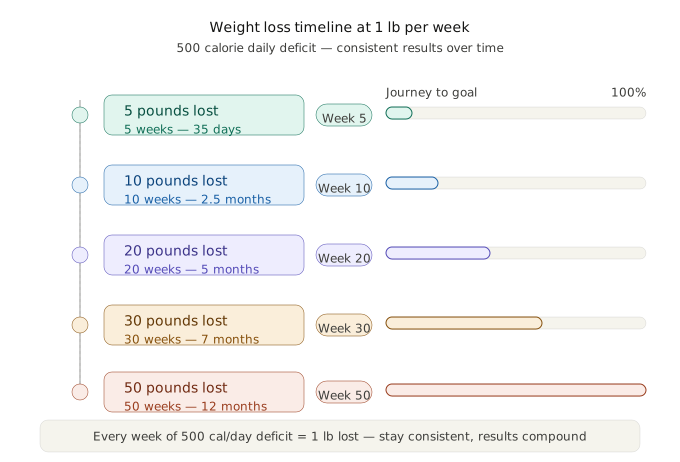
“Once you know how many calories to lose 1 pound a week, here’s exactly how long your journey will take:”
| Weight to Lose | Time Required |
|---|---|
| 5 pounds | ~5 weeks |
| 10 pounds | ~10 weeks |
| 20 pounds | ~20 weeks (~5 months) |
| 30 pounds | ~30 weeks (~7 months) |
| 50 pounds | ~50 weeks (~12 months) |
Remember: weight loss is rarely perfectly linear. You may lose more some weeks and less others — that’s completely normal.
When to Adjust Your Calorie Deficit
Your calorie needs change as you lose weight. As you get lighter, your TDEE decreases. Recalculate your TDEE and calorie goal every 10–15 pounds lost or every 4–6 weeks.
Also watch for these signs that your deficit may be too aggressive:
- Constant fatigue or brain fog
- Hair loss or brittle nails
- Loss of strength during workouts
- Intense, uncontrollable food cravings
If any of these appear, slightly increase your calorie intake or take a diet break for 1–2 weeks at maintenance.
Frequently Asked Questions (FAQs)
Q1: Can I lose 1 pound a week without exercise?
Q2: What if I’m not losing weight despite a 500-calorie deficit?
Q3: Is 1,200 calories a day safe for weight loss?
Q4: Does the type of food matter, or just calories?
Q5: How many calories should I eat to lose 1 pound a week if I’m very active?
Conclusion
The answer to how many calories to lose 1 pound a week is straightforward: create a 500-calorie daily deficit from your TDEE. That’s it. Calculate your numbers, choose a mix of smart eating and regular movement, and stay consistent week after week.
Weight loss isn’t about perfection — it’s about showing up consistently and making small, sustainable changes that add up over time. Start with your TDEE calculation today, set your calorie goal, and take that first step toward a healthier you.
Ready to find your exact calorie target? Use our free TDEE Calculator to instantly calculate how many calories you burn daily — and get your personalized calorie goal to lose 1 pound a week. No guesswork, just science.