
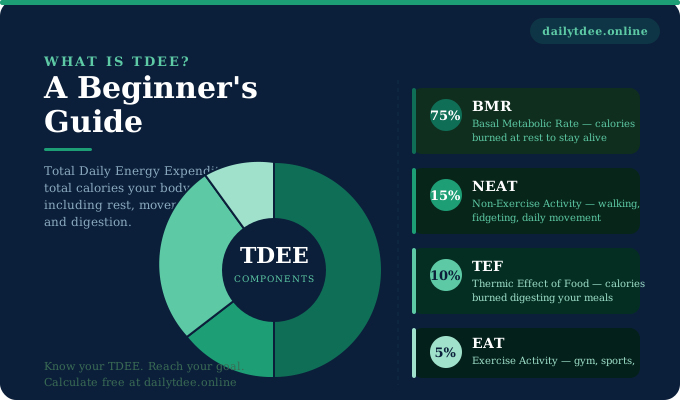
What Is TDEE? The Simple Definition for Beginners:
So, what is TDEE exactly?
Welcome to the ultimate what is TDEE beginner’s guide. If you have been searching for a clear, simple, and complete what is TDEE beginner’s guide, you have found it. This what is TDEE beginner’s guide will walk you through every single thing a beginner needs to know about TDEE — from the basic definition all the way to using it for real fitness results.
TDEE stands for Total Daily Energy Expenditure. In simple terms, TDEE is the total number of calories your body burns every single day. This what is TDEE beginner’s guide exists because most beginners never learn this number — and that is exactly why most beginners fail to reach their goals.
Whether your goal is fat loss, muscle building, or weight maintenance, this what is TDEE beginner’s guide is your starting point. Without knowing your TDEE, you are guessing. This what is TDEE beginner’s guide replaces guessing with a real, personalized number.
💡 Quick Start: Use the free TDEE Calculator at DailyTDEE.online — the fastest way to apply what you learn in this what is TDEE beginner’s guide.
TDEE stands for Total Daily Energy Expenditure. It is the total amount of energy — measured in calories — that your body uses in a 24-hour period. This includes every calorie burned from the moment you wake up to the moment you fall asleep: breathing, digesting food, walking to the kitchen, and every workout you do.
Think of your TDEE as your body’s personal calorie budget for the day:
- Eat equal to your TDEE → your weight stays the same
- Eat less than your TDEE → you lose weight
- Eat more than your TDEE → you gain weight
That is the core of this what is TDEE beginner’s guide — it is really that simple.
Table of Contents
Why Is TDEE Important for Beginners?
Most beginners focus on what to eat, but the most important question is actually how much to eat. Your TDEE answers that question with a real number based on your body — not a generic “eat 1,500 calories” advice that ignores your age, height, weight, and activity level.
Knowing your TDEE gives you:
- A personalized calorie target built for your body
- A clear direction — whether to eat more or less
- A scientific foundation for any diet or fitness plan
What Makes Up Your TDEE? (TDEE Beginner Breakdown)
A key part of this TDEE beginner’s guide is understanding what actually goes into your Total Daily Energy Expenditure. Your TDEE is made up of four components:
1. BMR — Basal Metabolic Rate
Your BMR is the number of calories your body burns at complete rest — just keeping your heart beating, lungs breathing, and brain working. For most people, BMR makes up 60–70% of their total TDEE.
🔗 Learn more: BMR vs TDEE — What’s the Difference?
2. TEF — Thermic Effect of Food
Every time you eat, your body burns calories to digest that food. This is called the Thermic Effect of Food and makes up about 10% of your TDEE. High-protein foods burn the most calories during digestion.
3. EAT — Exercise Activity Thermogenesis
This is the calories burned from planned workouts — gym sessions, running, cycling, and similar activities. The harder and more frequently you train, the bigger this number.
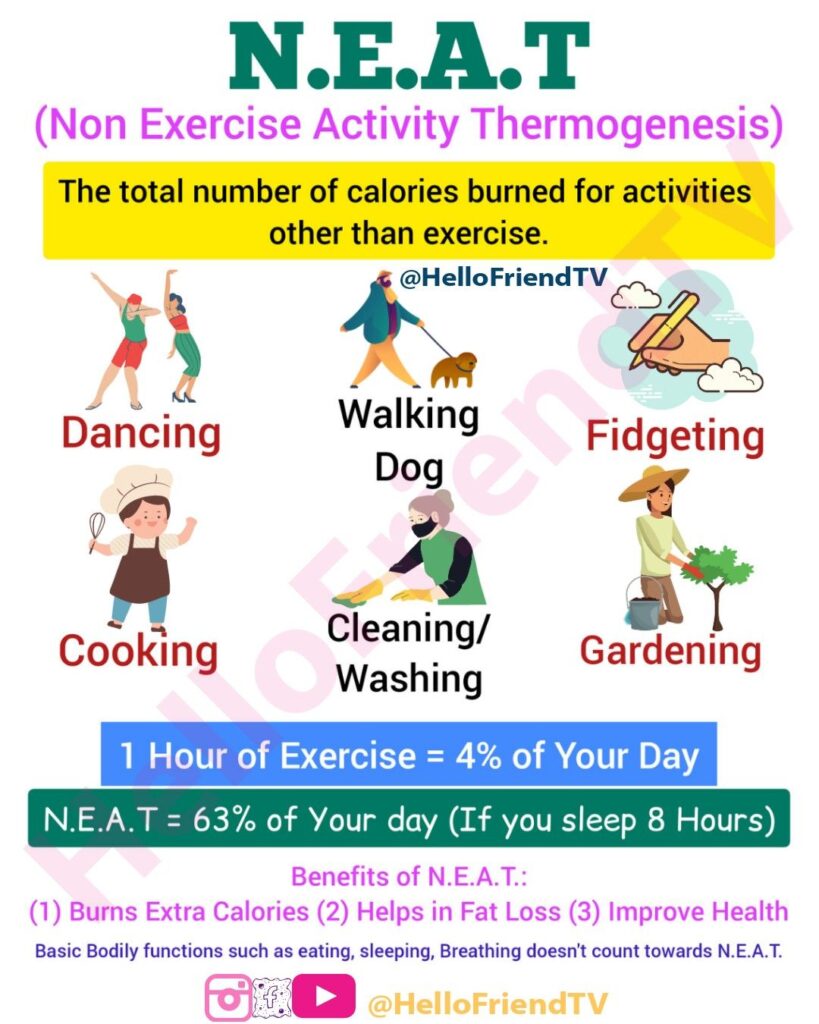
4. NEAT — Non-Exercise Activity Thermogenesis
NEAT is every calorie burned through movement that is NOT formal exercise — walking to your car, doing housework, fidgeting, climbing stairs. NEAT can vary by over 1,500 calories per day between people, making it one of the most important and overlooked parts of your TDEE as a beginner.
How to Calculate TDEE for Beginners — Step by Step:
This section of the what is TDEE beginner’s guide covers exactly how to calculate your own TDEE.
Calculating TDEE for beginners involves two simple steps:
Step 1 — Calculate Your BMR Using the Mifflin-St Jeor Equation
This is the most accurate BMR formula for beginners and is used by our calculator at DailyTDEE.online:
- Men: BMR = (10 × weight kg) + (6.25 × height cm) − (5 × age) + 5
- Women: BMR = (10 × weight kg) + (6.25 × height cm) − (5 × age) − 161
Step 2 — Multiply Your BMR by Your Activity Level
| Activity Level | Who This Is | Multiply BMR By |
|---|---|---|
| Sedentary | Desk job, little movement | × 1.2 |
| Lightly Active | Light exercise 1–3 days/week | × 1.375 |
| Moderately Active | Exercise 3–5 days/week | × 1.55 |
| Very Active | Hard exercise 6–7 days/week | × 1.725 |
| Extra Active | Physical job + daily training | × 1.9 |
Your TDEE = BMR × Activity Multiplier
Beginner Example
A 28-year-old woman, 163 cm, 68 kg, exercises 3 days per week:
- BMR = (10 × 68) + (6.25 × 163) − (5 × 28) − 161 = 1,440 calories
- TDEE = 1,440 × 1.55 = ~2,232 calories/day
She needs roughly 2,232 calories per day just to maintain her current weight. Eating 300–500 below that would result in steady, sustainable fat loss.
⚡ Skip the math: Our free TDEE Calculator for Beginners does all of this instantly. Just enter your details and get your number.
What Is TDEE Used For? A Beginner’s Guide to Your 3 Goals:
Now that you understand what TDEE is, here is how to actually use it — the most practical part of this what is TDEE beginner’s guide.
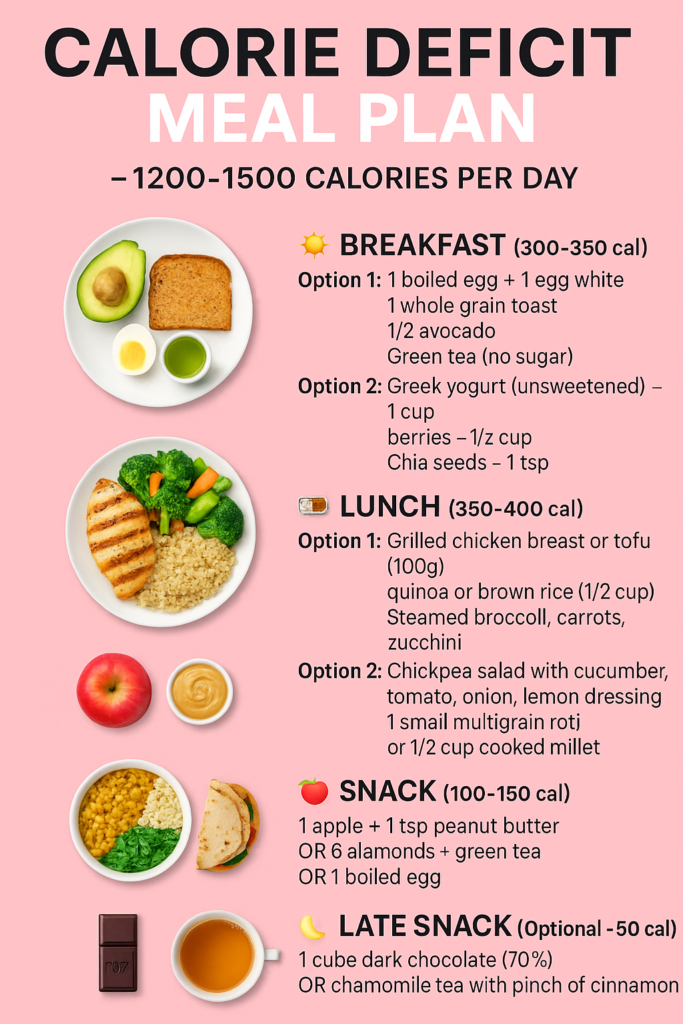
Using TDEE for Weight Loss (Calorie Deficit)
To lose weight as a beginner, eat 300–500 calories below your TDEE every day. This creates a “calorie deficit” that forces your body to burn stored fat for energy.
Example: TDEE is 2,200 calories → eat 1,700–1,900 calories to lose weight.
Avoid cutting more than 500–700 calories below your TDEE. Extreme deficits cause muscle loss, low energy, and a slower metabolism — the opposite of what beginners want.
🔗 Go deeper: How to Use Your TDEE for Weight Loss
Using TDEE for Muscle Gain (Calorie Surplus)
To build muscle, eat 200–300 calories above your TDEE daily. This small surplus gives your body the extra energy it needs to grow new muscle tissue without adding too much fat.
🔗 Go deeper: TDEE for Muscle Gain — How Many Calories to Bulk?
Using TDEE for Maintenance
Eating exactly at your TDEE keeps your weight stable. This is perfect for beginners who simply want to stay at their current weight while improving body composition through exercise.
The Biggest TDEE Mistakes Beginners Make:
No what is TDEE beginner’s guide would be complete without covering the most common beginner mistakes:
Mistake 1 — Overestimating Activity Level Most beginners select “moderately active” when they are actually sedentary. This inflates your TDEE estimate and causes you to eat too much, stalling fat loss. Be honest about how much you actually move.
Mistake 2 — Using a Generic Calorie Target Eating “1,200 calories” because someone online said so ignores your personal TDEE entirely. A 6’2″ active man and a 5’2″ sedentary woman have completely different TDEEs. Use your own number.
Mistake 3 — Never Recalculating Your TDEE changes as your weight changes. Every time you lose or gain 4–5 kg, recalculate your TDEE at DailyTDEE.online to keep your targets accurate.
Mistake 4 — Ignoring NEAT Beginners focus only on gym workouts, but NEAT — daily movement outside the gym — can be even more powerful for burning calories. Simple habits like walking more, taking the stairs, and standing at your desk can raise your TDEE significantly.
🔗 Read more: 5 Common TDEE Mistakes Beginners Make
What Is TDEE vs BMR? Beginner’s Guide Comparison:
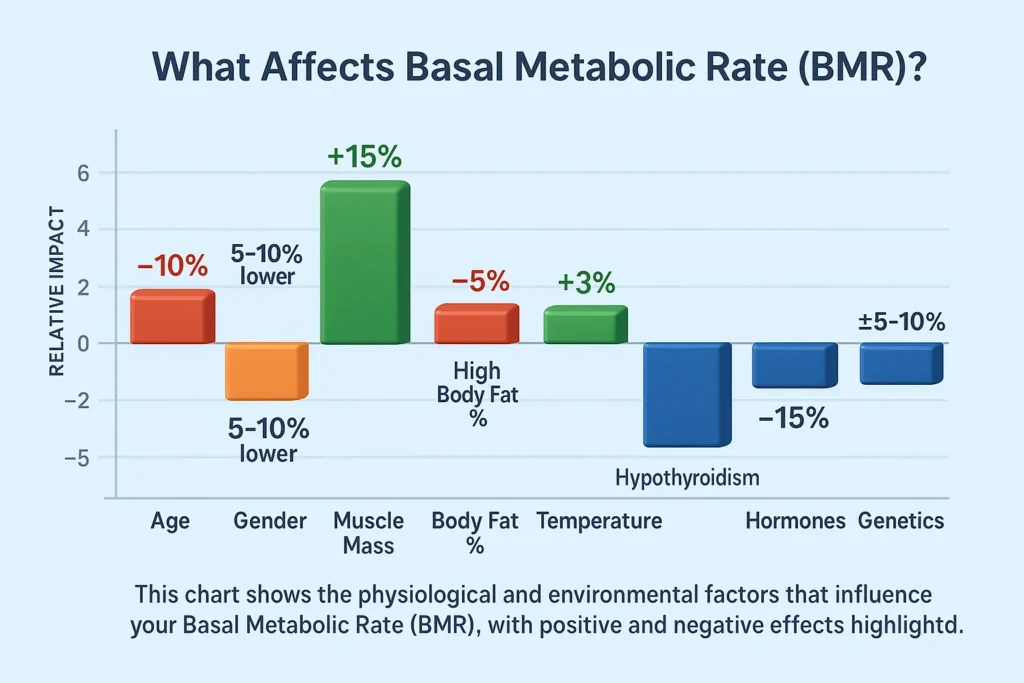
One of the most searched questions in any what is TDEE beginner’s guide is: what’s the difference between TDEE and BMR?
| BMR | TDEE | |
|---|---|---|
| What it measures | Calories at complete rest | Calories burned all day |
| Includes activity? | ❌ No | ✅ Yes |
| Use for dieting? | No — too low | ✅ Yes — your real target |
| Example (same person) | 1,440 calories | 2,232 calories |
The key rule for beginners: Always base your calorie goals on your TDEE, never your BMR. Eating at your BMR means eating far too little and puts your body under serious stress.
🔗 Full comparison: BMR vs TDEE — Which Number Should You Use?
Does TDEE Change Over Time? What Beginners Need to Know:
Yes — and this is crucial for beginners to understand. Your TDEE is not a fixed number for life. It changes when:
- Your weight changes — less body mass = lower TDEE
- Your activity level changes — new job, injury, new training routine
- You age — metabolism gradually slows over the years
- You diet for a long time — the body adapts and slightly lowers TDEE to conserve energy (called metabolic adaptation)
As a beginner’s rule of thumb: Recalculate your TDEE every 4–6 weeks using our free TDEE Calculator to make sure your calorie targets are still accurate.
Frequently Asked Questions:
Q1. What is TDEE in simple words for a beginner?
Q2. How do I find my TDEE as a beginner?
Q3. Is TDEE the same as calories I should eat per day?
Q5. What is a normal TDEE for a beginner?
Conclusion
What Is TDEE? A Beginner’s Guide Summary:
If you came here asking what is TDEE, here is everything from this beginner’s guide in one place:
- TDEE = Total Daily Energy Expenditure — your total daily calorie burn
- It is made up of your BMR + TEF + EAT + NEAT
- To lose weight, eat 300–500 calories below your TDEE
- To build muscle, eat 200–300 calories above your TDEE
- To maintain weight, eat at your TDEE
- Recalculate your TDEE every 4–6 weeks as your body changes
This what is TDEE beginner’s guide gives you everything you need to stop guessing and start seeing real results. The next step is simple — find your number.
🎯 Calculate Your TDEE Now — Free & Instant Use the TDEE Calculator at DailyTDEE.online to get your personalized daily calorie target in seconds. No account needed.