
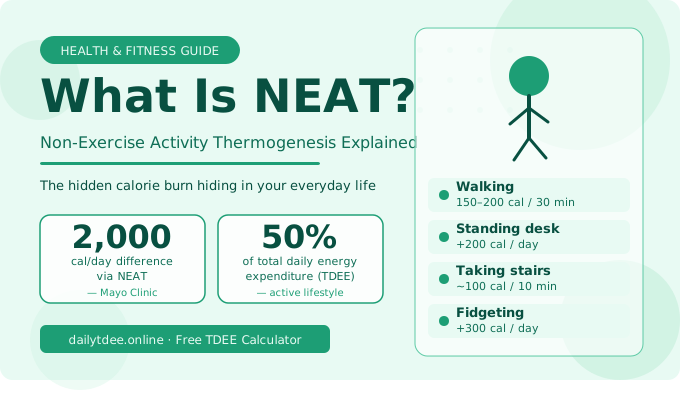
Non-exercise activity thermogenesis explained:
Most people obsess over gym time. They track every set, every rep, every minute on the treadmill. Then they sit at a desk for 9 hours straight and wonder why the scale won’t budge.
That’s where NEAT comes in.But first — what is NEAT? Non-Exercise Activity Thermogenesis is the term scientists use to describe all the calories your body burns through movement that isn’t planned exercise. And it matters more than most people realize.
Table of Contents
what is NEAT exactly?
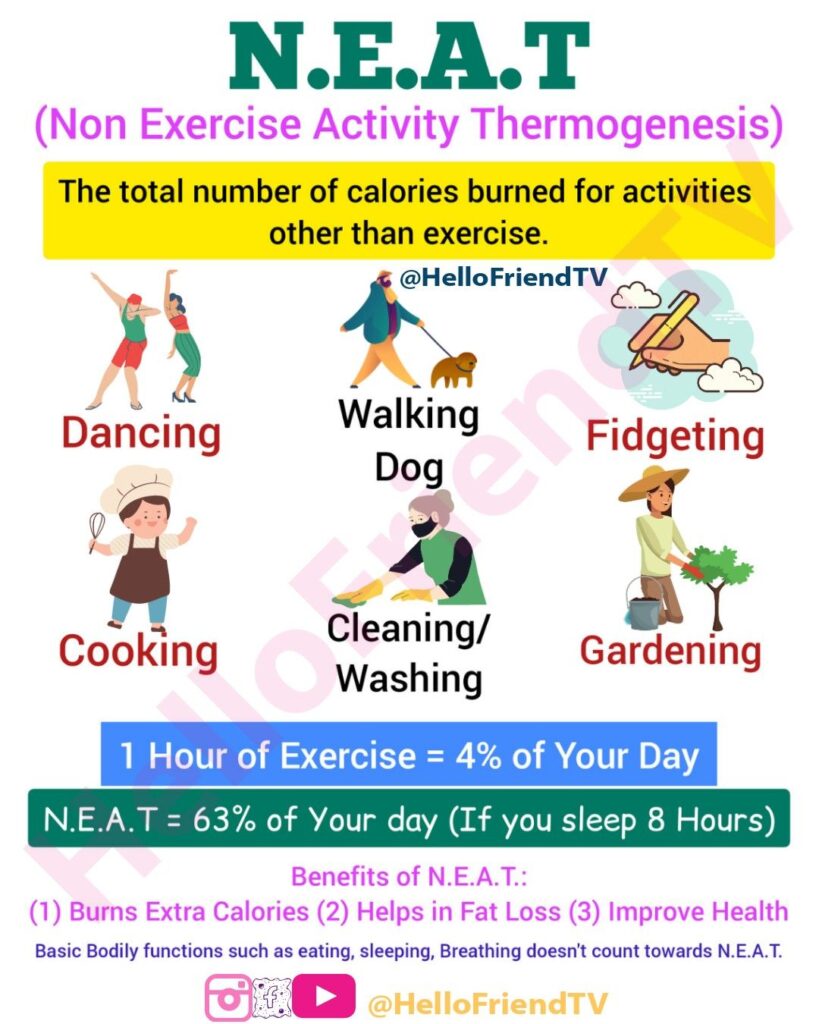
NEAT stands for Non-Exercise Activity Thermogenesis. It’s all the calories your body burns from movement that has nothing to do with planned exercise.
Walking to your car. Fidgeting. Standing up to grab water. Taking the stairs. Carrying grocery bags. Gesturing with your hands while you talk. All of it counts.
And the calorie numbers here are bigger than most people expect.
How many calories does NEAT actually burn?
Research from the Mayo Clinic found that NEAT can vary by up to 2,000 calories per day between two people of similar size. That’s not a typo.
A construction worker burns dramatically more calories than an office worker, even if both skip the gym entirely. The difference is just daily movement.
For most people, NEAT accounts for roughly 15% to 50% of total daily energy expenditure, depending on lifestyle. Sedentary people sit at the low end. People who move around constantly land near the top.
This is why your TDEE (total daily energy expenditure) can shift so much just by changing how active your day is outside the gym.
The 4 parts of your total calorie burn:
To fully understand what is NEAT and Non-Exercise Activity Thermogenesis, it helps to see where it fits inside your total calorie burn. Your body burns calories 4 ways every day:
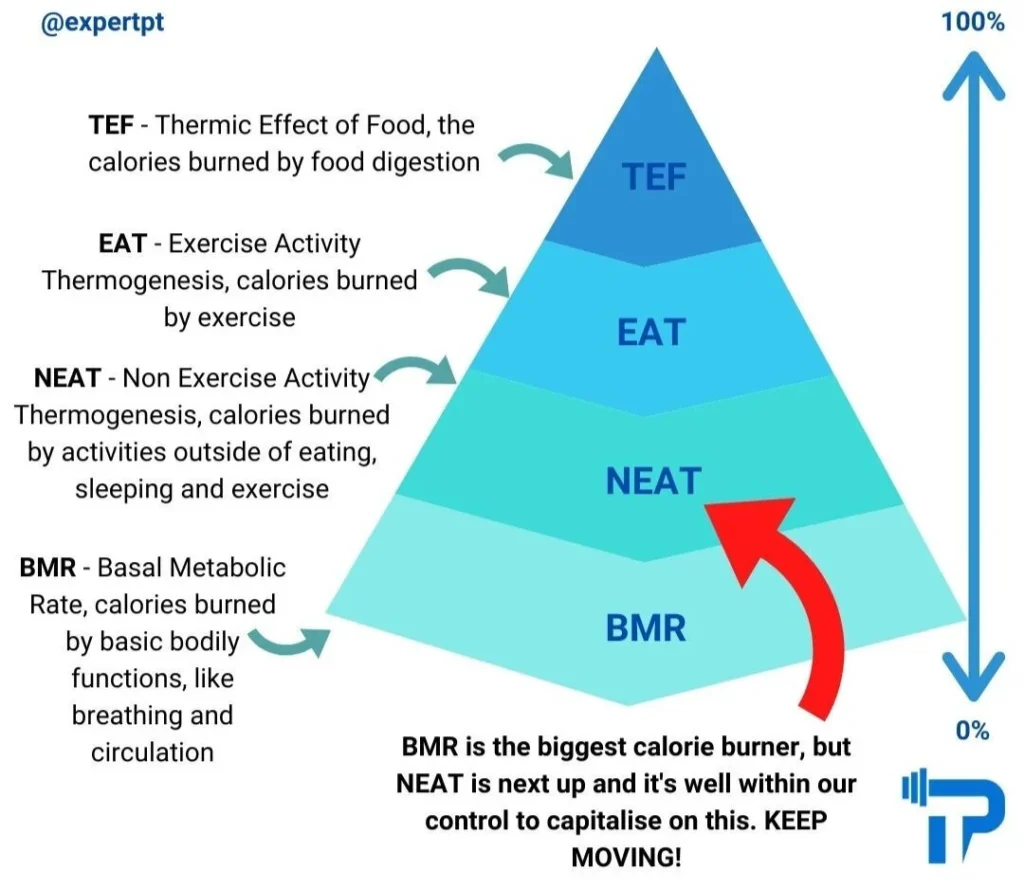
- BMR (Basal Metabolic Rate) — calories burned just keeping you alive. Breathing, heart beating, organs functioning.
- TEF (Thermic Effect of Food) — energy used to digest what you eat. Usually around 10% of total intake.
- EAT (Exercise Activity Thermogenesis) — intentional workouts. Gym sessions, runs, cycling classes.
- NEAT (Non-Exercise Activity Thermogenesis) — everything else. Every step, every fidget, every trip up the stairs.
Most people know about BMR and exercise. Non-Exercise Activity Thermogenesis is the one they ignore. And it’s probably the one with the most room to grow.
Why NEAT drops when you diet (and why that’s a problem):
Here’s something that catches a lot of people off guard. When you cut calories and lose weight, your body doesn’t just sit there. It adapts.
One of the first things it does is reduce NEAT, almost automatically.
You fidget less. You take fewer steps without realizing it. You sit more. You feel tired and unconsciously conserve movement. Researchers call this adaptive thermogenesis, and it’s a big reason why fat loss slows down even when someone’s still eating at a deficit.
A 2012 study published in the Journal of Clinical Investigation tracked people through weight loss and found significant drops in NEAT, even before metabolic rate slowed. The body was cutting calorie output before it cut metabolic rate.
So if you’re eating right and training hard but the scale stalls, your NEAT may have quietly dropped without you noticing.
What actually drives NEAT?
Now that you know what is NEAT, it’s worth understanding what drives Non-Exercise Activity Thermogenesis in the first place. A few key factors control it:
Your job. A nurse walking hospital floors for 8 hours burns far more than someone on Zoom calls all day. Your work environment has a massive impact on your Non-Exercise Activity Thermogenesis — more than most people think.
Your personality. Fidgeters naturally burn more. Studies show that naturally restless people can burn an extra 300–350 calories daily through unconscious movement alone. Some of this is genetics — meaning your baseline what is NEAT output is partly hardwired.
Your environment. If you live on the 4th floor with no elevator, you’re stacking Non-Exercise Activity Thermogenesis every day. If your office is 200 steps from your car and you eat lunch at your desk, you’re not.
Your mood and stress. Low energy, depression, and high stress tend to kill movement. You sit more, move less, and quietly reduce your Non-Exercise Activity Thermogenesis without even noticing.
How to raise your NEAT without going to the gym:
You don’t need a fitness plan. You just need to move more during the hours you’re already awake. Here’s how to increase Non-Exercise Activity Thermogenesis starting today — no gym required. Once you understand what is NEAT, boosting it is surprisingly simple:
Walk more. A 30-minute walk burns around 150–200 calories. Do it after lunch. Park further away. Take calls on foot. Walking is Non-Exercise Activity Thermogenesis in its purest, simplest form.
Stand instead of sit. Standing burns about 50 more calories per hour than sitting. A standing desk for 4 hours adds up to roughly 200 extra calories of Non-Exercise Activity Thermogenesis burned daily.
Take the stairs. Every time. 10 minutes of stair climbing burns around 100 calories. Every flight you take is Non-Exercise Activity Thermogenesis stacking up quietly throughout your day.
Do things manually. Walk to a coworker’s desk instead of messaging them. Return the shopping cart yourself. Carry your own bags. Each small choice is a vote for higher Non-Exercise Activity Thermogenesis.
Fidget. Tap your foot. Bounce your leg. It sounds trivial but at scale, regular fidgeting is proven Non-Exercise Activity Thermogenesis — adding real calorie burn across a full day.
Clean, cook, garden. A full house clean for 2 hours burns 200–400 calories depending on intensity. Cooking a meal burns more than ordering one. All of it counts toward your daily Non-Exercise Activity Thermogenesis.
None of this requires willpower. You’re mostly just picking the slightly more active version of things you’d do anyway — and stacking Non-Exercise Activity Thermogenesis without even trying. That’s the beauty of understanding what is NEAT.
NEAT vs. exercise: which one matters more?
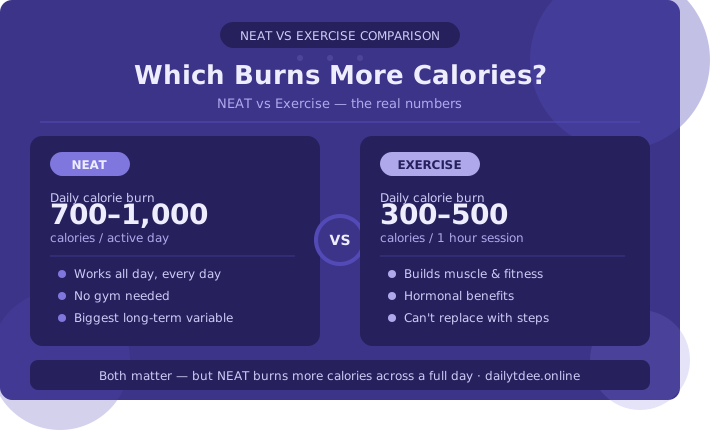
A common question once people understand what is NEAT is how Non-Exercise Activity Thermogenesis stacks up against traditional exercise. The honest answer: they do different things.
Exercise builds muscle, improves cardio fitness, and creates acute hormonal responses that Non-Exercise Activity Thermogenesis simply can’t replicate. You can’t skip the gym and make it up with extra steps.
But for daily calorie burn and long-term weight management, Non-Exercise Activity Thermogenesis is often the bigger variable. An hour of moderate gym training burns maybe 300–500 calories. What is NEAT capable of? Over a full active day it can hit 700–1,000 calories or more — in someone who’s just consistently moving.
The people who stay lean without trying too hard usually have high Non-Exercise Activity Thermogenesis. They’re just active by default — and their NEAT is working around the clock without them even realizing it.
How to Track Your NEAT:
You probably can’t track Non-Exercise Activity Thermogenesis perfectly — and that’s fine.
The easiest proxy is daily step count. A sedentary person might hit 3,000–4,000 steps. An active person hits 10,000–15,000. The gap in calorie burn between those two numbers is a direct reflection of the difference in Non-Exercise Activity Thermogenesis.
Most fitness trackers and smartwatches give a rough NEAT estimate by subtracting logged workouts from total active calories. It’s not precise, but it tells you which direction your Non-Exercise Activity Thermogenesis is moving.
If you’re using a TDEE calculator on dailytdee.online, your activity multiplier directly captures your Non-Exercise Activity Thermogenesis level. “Sedentary” assumes low NEAT. “Lightly active” assumes moderate Non-Exercise Activity Thermogenesis. Choosing the right multiplier matters far more than most people realize — because what is NEAT if not the single biggest variable in your daily activity level?
The Bottom Line on NEAT:
So — what is NEAT? And why does Non-Exercise Activity Thermogenesis matter so much?
Because it’s the calorie burn hiding in your regular day. It doesn’t require a gym membership, a coach, or a workout plan. It just requires moving more in the hours you’re already awake. Standing instead of sitting. Walking instead of driving. Taking the long way instead of the shortcut.
For a lot of people, fixing their Non-Exercise Activity Thermogenesis is easier than fixing their diet and more sustainable than adding more gym sessions. The body adapts to exercise. It doesn’t adapt to just living an active life.
So before you add another workout to your week, ask yourself — what is NEAT doing for me right now? Look at how you’re spending the other 23 hours.
That’s where Non-Exercise Activity Thermogenesis lives. That’s where NEAT makes all the difference.
💡 Want to see how your activity level affects your TDEE? Use the TDEE calculator on dailytdee.online to see how much your daily movement really changes your maintenance calories.