
If you’ve ever searched for how many calories to eat per day, you’ve likely come across two terms: BMR and TDEE. They sound similar, and many people use them interchangeably — but they mean very different things. Understanding the TDEE vs BMR difference is one of the most important steps you can take toward smarter nutrition, effective weight loss, or sustainable muscle gain.
In this guide, we’ll break down exactly what each term means, how they’re calculated, and — most importantly — which one you should actually use when planning your diet.
Table of Contents
What Is BMR (Basal Metabolic Rate)?
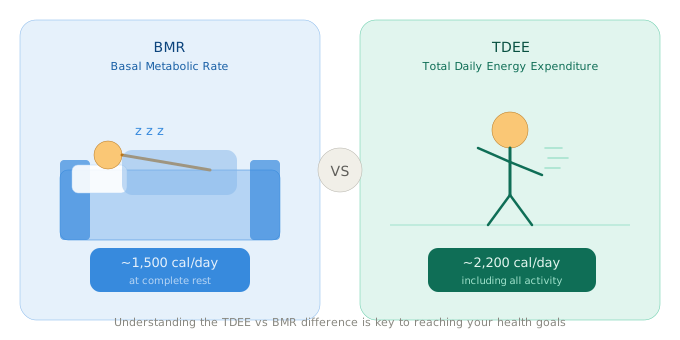
BMR, or Basal Metabolic Rate, is the number of calories your body needs to perform its most basic life-sustaining functions — things like breathing, circulating blood, regulating body temperature, and keeping your organs running — while you are completely at rest.
Think of BMR as the energy cost of simply existing. If you were to lie in bed all day without moving, eating, or doing anything, your body would still burn calories equal to your BMR just to stay alive.
How Is BMR Calculated?
The most commonly used formula is the Mifflin-St Jeor Equation, which research confirms is the most accurate BMR formula for general use for both normal and overweight individuals.
- Men: BMR = (10 × weight in kg) + (6.25 × height in cm) − (5 × age in years) + 5
- Women: BMR = (10 × weight in kg) + (6.25 × height in cm) − (5 × age in years) − 161
Example: A 30-year-old woman, 165 cm tall, weighing 65 kg: BMR = (10 × 65) + (6.25 × 165) − (5 × 30) − 161 = 1,422 calories/day
This is the minimum calorie floor — not a target for eating.
What Is TDEE (Total Daily Energy Expenditure)?
TDEE, or Total Daily Energy Expenditure, is the total number of calories your body burns in a full day, accounting for all physical activity — workouts, walking, work, chores, and even fidgeting.
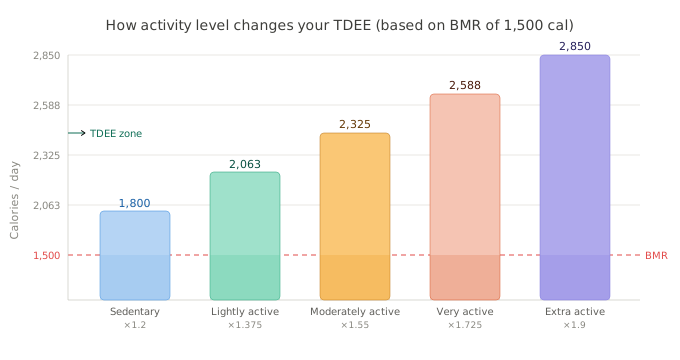
TDEE is your BMR multiplied by an activity multiplier that reflects your lifestyle:
| Activity Level | Multiplier | Description |
|---|---|---|
| Sedentary | × 1.2 | Little or no exercise |
| Lightly Active | × 1.375 | Light exercise 1–3 days/week |
| Moderately Active | × 1.55 | Moderate exercise 3–5 days/week |
| Very Active | × 1.725 | Hard exercise 6–7 days/week |
| Extra Active | × 1.9 | Physical job + hard training |
Using the same example above: If the woman exercises 3–5 days/week: TDEE = 1,422 × 1.55 = 2,204 calories/day
That’s 782 more calories than her BMR — a significant difference!
TDEE vs BMR Difference: A Side-by-Side Comparison:
| Activity Level | Multiplier | Description |
|---|---|---|
| Sedentary | × 1.2 | Little or no exercise |
| Lightly Active | × 1.375 | Light exercise 1–3 days/week |
| Moderately Active | × 1.55 | Moderate exercise 3–5 days/week |
| Very Active | × 1.725 | Hard exercise 6–7 days/week |
| Extra Active | × 1.9 | Physical job + hard training |
Using the same example above: If the woman exercises 3–5 days/week: TDEE = 1,422 × 1.55 = 2,204 calories/day
That’s 782 more calories than her BMR — a significant difference!
TDEE vs BMR Difference: A Side-by-Side Comparison
| Feature | BMR | TDEE |
|---|---|---|
| Includes activity? | ❌ No | ✅ Yes |
| Used for daily calorie goals? | ❌ Not recommended | ✅ Yes |
| Reflects real-world energy needs? | ❌ No | ✅ Yes |
| Useful for? | Understanding baseline metabolism | Planning diet & nutrition |
| Changes with activity level? | ❌ No | ✅ Yes |
The core TDEE vs BMR difference is simple: BMR is your resting baseline, while TDEE is your real-world calorie burn. TDEE always equals or exceeds BMR.
Which One Should You Use?
Use BMR if you want to:
- Understand your minimum caloric needs
- Learn how your metabolism compares to others
- Get a starting point for advanced calculations
Use TDEE if you want to:
- Set realistic daily calorie targets
- Lose weight by creating a calorie deficit
- Gain muscle by eating in a calorie surplus
- Maintain your current weight accurately
The short answer: For any practical diet or fitness goal, always use TDEE.
How to Use TDEE for Weight Loss, Gain, or Maintenance
Once you know your TDEE, applying it is straightforward,If you haven’t calculated yours yet, use this [free TDEE calculator]
🔻 For Weight Loss:
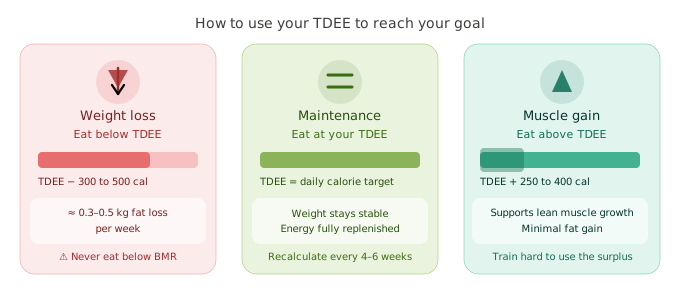
Eat 300–500 calories below your TDEE per day. This creates a moderate deficit that leads to roughly 0.3–0.5 kg of fat loss per week — sustainable and safe.
⚠️ Never eat below your BMR for extended periods. This triggers muscle loss and metabolic slowdown.
🔺 For Muscle Gain:
Eat 250–400 calories above your TDEE. This “lean bulk” provides enough surplus for muscle growth without excessive fat gain.
⚖️ For Maintenance:
Eat at your TDEE. This keeps your weight stable while fueling all your daily activities.
Common Mistakes When Using BMR and TDEE
1:Eating at BMR instead of TDEE — This severely under-fuels the body for anyone who isn’t completely bedridden.
2:Overestimating activity level — Choosing “Very Active” when you work a desk job inflates your TDEE and can cause weight gain.
3:Never recalculating — As your weight changes, so does your BMR and TDEE. Recalculate every 4–6 weeks.
4: Ignoring non-exercise activity (NEAT) — Daily movement like walking and standing can burn hundreds of extra calories.
BMR vs TDEE: Which Formula Is Most Accurate?
Both BMR and TDEE are estimates, not perfect measurements. The Mifflin-St Jeor equation is currently considered the most accurate for the general population. However, body composition matters too — someone with more muscle mass will have a higher BMR at the same weight as someone with more fat.
For the most accurate results, consider using a TDEE calculator that factors in your weight, height, age, sex, and activity level together.
Conclusion
Understanding the TDEE vs BMR difference is foundational to any effective nutrition strategy. BMR tells you the minimum your body needs to survive. TDEE tells you what you actually need to thrive. For weight loss, muscle building, or simply maintaining a healthy body — TDEE is your number.
Stop guessing your calorie needs. Calculate your TDEE today and start eating with purpose.
📌 Frequently Asked Questions (FAQs)
Q1: Is TDEE the same as BMR?
Q2: Should I eat my BMR or TDEE to lose weight?
Q3: How often should I recalculate my TDEE?
Q4: Can TDEE change over time?
Q5: What is a good TDEE for weight loss?
Ready to find your exact numbers? Use our free TDEE Calculator to calculate your Total Daily Energy Expenditure in seconds — personalized to your weight, height, age, and activity level. Take the guesswork out of your diet and start hitting your goals today.