
If you’ve ever wondered why some people eat more than others without gaining weight — or why your diet stopped working — the answer often comes down to TDEE.
TDEE stands for Total Daily Energy Expenditure, and it represents the total number of calories your body burns in a single day. Understanding your TDEE is the foundation of any successful weight loss, muscle gain, or maintenance plan.
But here’s the real question most people ask: What is a good TDEE? Is yours too low? Too high? Just right?
In this guide, we’ll break down average TDEE values by age, gender, and fitness goal — so you can finally understand your numbers and take control of your nutrition.
Table of Contents
What Is TDEE and Why Does It Matter?
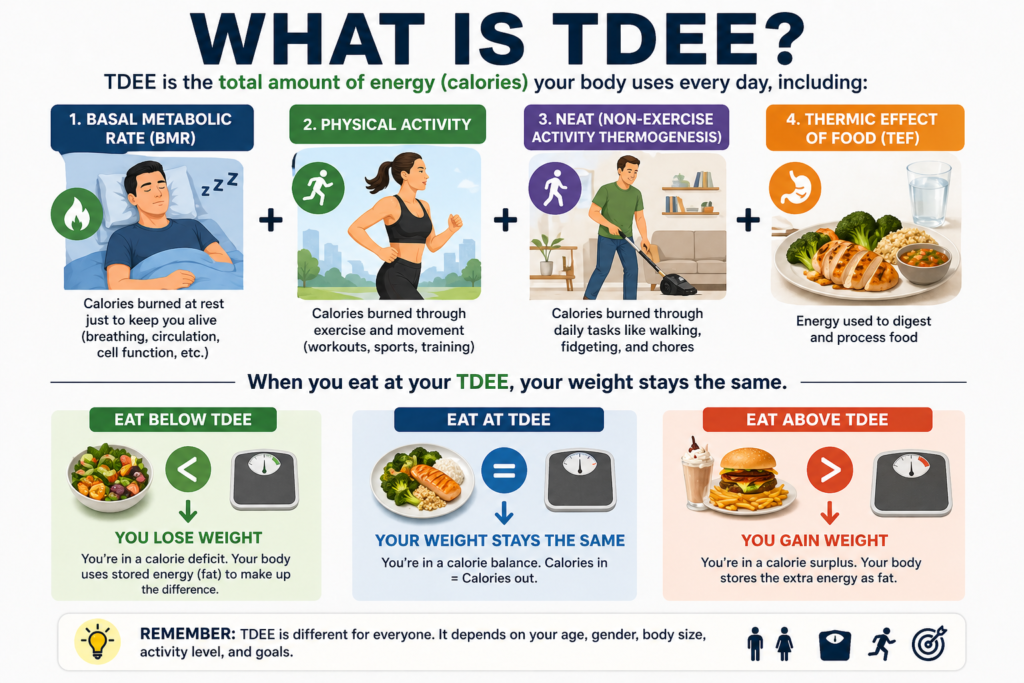
TDEE is the total amount of energy (calories) your body uses every day, including:
- Basal Metabolic Rate (BMR) — calories burned at rest just to keep you alive
- Physical Activity — calories burned through exercise and movement
- NEAT (Non-Exercise Activity Thermogenesis) — calories burned through daily tasks like walking, fidgeting, and chores
- Thermic Effect of Food (TEF) — energy used to digest and process food
When you eat at your TDEE, your weight stays the same. Eat below it, and you lose weight. Eat above it, and you gain weight.
💡 Pro Tip: Use a TDEE calculator to get a personalized estimate based on your height, weight, age, and activity level — it’s the most accurate starting point.
TDEE is the total amount of energy (calories) your body uses every day, including:
- Basal Metabolic Rate (BMR) — calories burned at rest just to keep you alive
- Physical Activity — calories burned through exercise and movement
- NEAT (Non-Exercise Activity Thermogenesis) — calories burned through daily tasks like walking, fidgeting, and chores
- Thermic Effect of Food (TEF) — energy used to digest and process food
When you eat at your TDEE, your weight stays the same. Eat below it, and you lose weight. Eat above it, and you gain weight.
💡 Pro Tip: Use a Tdee Calculator to get a personalized estimate based on your height, weight, age, and activity level — it’s the most accurate starting point.
TDEE is the total amount of energy (calories) your body uses every day, including:
- Basal Metabolic Rate (BMR) — calories burned at rest just to keep you alive
- Physical Activity — calories burned through exercise and movement
- NEAT (Non-Exercise Activity Thermogenesis) — calories burned through daily tasks like walking, fidgeting, and chores
- Thermic Effect of Food (TEF) — energy used to digest and process food
When you eat at your TDEE, your weight stays the same. Eat below it, and you lose weight. Eat above it, and you gain weight.
💡 Pro Tip: Use a TDEE calculator to get a personalized estimate based on your height, weight, age, and activity level — it’s the most accurate starting point.
What Is a Good TDEE? (General Benchmarks)
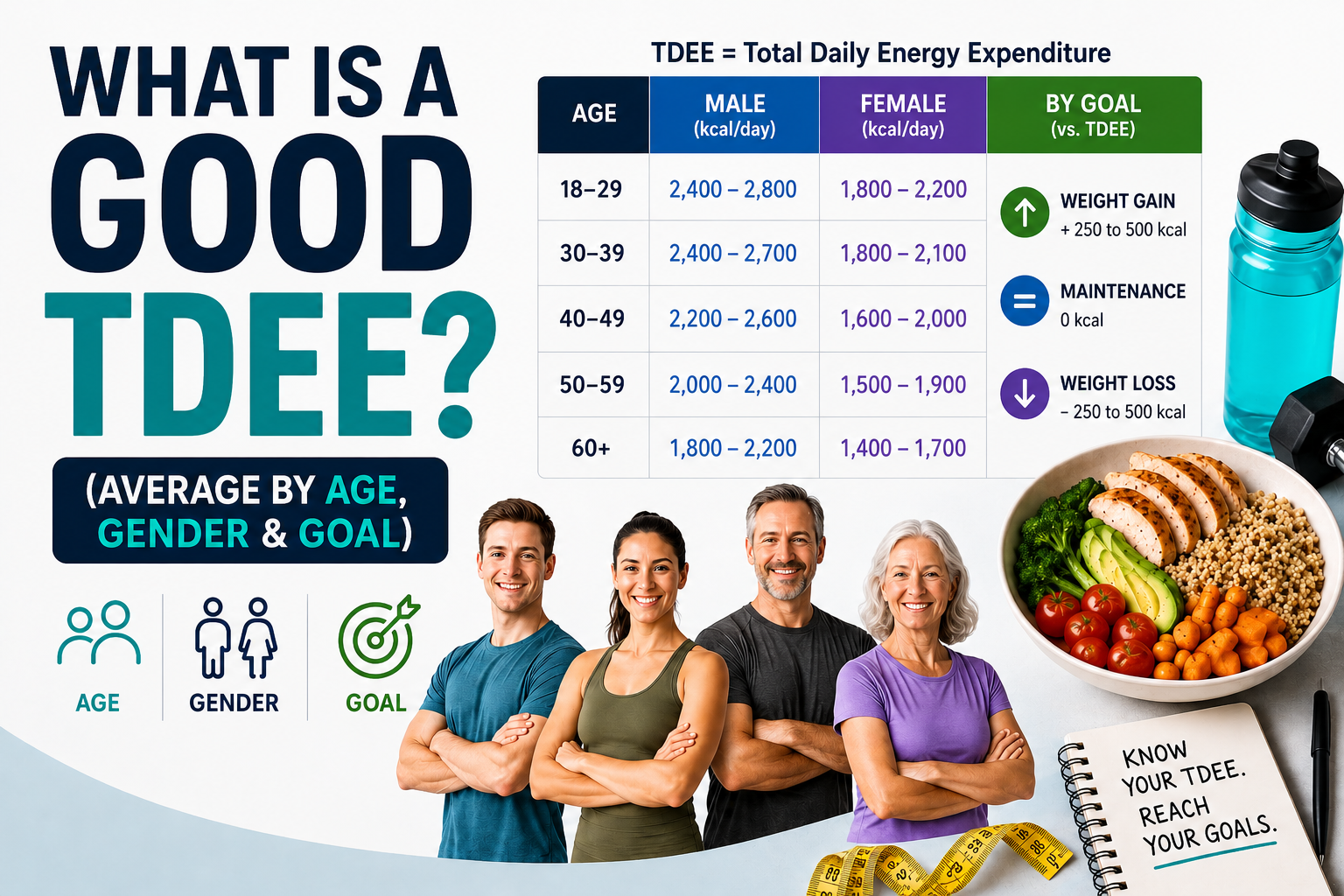
There’s no single “perfect” TDEE — it varies based on your body size, age, gender, and lifestyle. However, here are general reference ranges:
| Category | Average TDEE (Calories/Day) |
|---|---|
| Sedentary adult (low activity) | 1,600 – 2,000 |
| Moderately active adult | 2,000 – 2,500 |
| Active adult | 2,500 – 3,000 |
| Highly active / athlete | 3,000 – 4,000+ |
These ranges give you a starting point, but your ideal TDEE depends on much more — especially your age and gender.
Average TDEE by Gender
Average TDEE for Women
Women generally have a lower TDEE than men due to differences in muscle mass and hormones.
- Sedentary women: ~1,600 – 1,800 calories/day
- Moderately active women: ~1,900 – 2,200 calories/day
- Active women: ~2,200 – 2,500 calories/day
- Very active / athletic women: ~2,500 – 3,200 calories/day
Women with more muscle mass (e.g., those who strength train regularly) will typically fall on the higher end of these ranges.
Women generally have a lower TDEE than men due to differences in muscle mass and hormones.
- Sedentary women: ~1,600 – 1,800 calories/day
- Moderately active women: ~1,900 – 2,200 calories/day
- Active women: ~2,200 – 2,500 calories/day
- Very active / athletic women: ~2,500 – 3,200 calories/day
Women with more muscle mass (e.g., those who strength train regularly) will typically fall on the higher end of these ranges.
Women generally have a lower TDEE than men due to differences in muscle mass and hormones.
- Sedentary women: ~1,600 – 1,800 calories/day
- Moderately active women: ~1,900 – 2,200 calories/day
- Active women: ~2,200 – 2,500 calories/day
- Very active / athletic women: ~2,500 – 3,200 calories/day
Women with more muscle mass (e.g., those who strength train regularly) will typically fall on the higher end of these ranges.
Average TDEE for Men
Men typically have higher TDEE values due to greater lean muscle mass and higher testosterone levels.
- Sedentary men: ~2,000 – 2,200 calories/day
- Moderately active men: ~2,400 – 2,800 calories/day
- Active men: ~2,800 – 3,200 calories/day
- Very active / athletic men: ~3,200 – 4,500+ calories/day
Male athletes in endurance or strength sports can exceed 4,000–5,000 calories per day.
Average TDEE by Age
Your metabolism naturally changes as you age. Here’s a general overview of how TDEE shifts across life stages:
TDEE in Your 20s
This is typically the peak metabolic period. Active individuals in their 20s often have the highest TDEE of their lives.
- Women (20–29): ~1,900 – 2,400 cal/day
- Men (20–29): ~2,400 – 3,000 cal/day
TDEE in Your 30s
Metabolism begins to slow slightly. Muscle mass may start declining if strength training isn’t maintained.
- Women (30–39): ~1,800 – 2,200 cal/day
- Men (30–39): ~2,200 – 2,800 cal/day
TDEE in Your 50s and Beyond
TDEE continues to decline with age. However, staying physically active and preserving muscle mass can significantly offset this decline.
- Women (50+): ~1,600 – 2,000 cal/day
- Men (50+): ~1,900 – 2,400 cal/day
💡 Want to know your exact TDEE for your age group? Try our free TDEE calculator — just enter your stats and get your personalized number in seconds.
What Is a Good TDEE for Your Fitness Goal?
Knowing your TDEE is only half the equation. How you adjust from that number depends entirely on what you want to achieve.
TDEE for Weight Loss
To lose weight, you need to eat in a calorie deficit — typically 300 to 500 calories below your TDEE.
- Example: If your TDEE is 2,200 calories, aim for 1,700 – 1,900 calories/day
- This creates a safe, sustainable deficit of ~0.5–1 lb of fat loss per week
- Avoid going more than 1,000 calories below TDEE — this risks muscle loss, fatigue, and nutrient deficiencies
TDEE for Muscle Gain (Bulking)
To build muscle, you need to eat in a calorie surplus — typically 200 to 400 calories above your TDEE.
- Example: If your TDEE is 2,500 calories, aim for 2,700 – 2,900 calories/day
- This “lean bulk” approach maximizes muscle growth while minimizing fat gain
- Combine with a consistent resistance training program for best results
TDEE for Weight Maintenance
If you’re happy with your current body composition, simply eat at your TDEE.
- This is the most sustainable long-term approach
- Recalculate your TDEE every 4–6 weeks as your weight and activity level change
- Track food intake with apps like MyFitnessPal to stay accurate
Factors That Affect What a “Good” TDEE Looks Like for You
Beyond age and gender, several personal factors influence your TDEE:
1. Body Composition
More muscle = higher TDEE. Two people of the same weight but different muscle-to-fat ratios can have significantly different calorie needs.
2. Activity Level
This is the biggest variable. Someone who exercises 5–6 days a week will have a TDEE 500–1,000+ calories higher than a sedentary person of the same size.
3. Hormonal Health
Thyroid disorders, insulin resistance, and other hormonal issues can dramatically reduce or increase TDEE.
4. Genetics
Some people are naturally more metabolically efficient (or inefficient). Genetics play a role in both BMR and how your body responds to exercise.
5. Diet History
Prolonged calorie restriction (chronic dieting) can lower metabolic rate over time — a phenomenon called metabolic adaptation.
How to Calculate Your TDEE Accurately
The most reliable way to find your TDEE is to use a TDEE calculator that accounts for:
- Age
- Gender
- Height and Weight
- Activity Level (sedentary, lightly active, moderately active, very active)
Most calculators use the Mifflin-St Jeor equation to estimate BMR, then apply an activity multiplier to get your TDEE.
🔗 Use our free TDEE calculator to get your personalized result in under 60 seconds — no sign-up required.
You can also track your calories for 2–3 weeks and compare to weight changes to reverse-engineer your true TDEE from real-world data.
Signs Your TDEE Estimate Might Be Off
Even the best calculator gives an estimate. Watch for these signs that your TDEE needs adjustment:
- Unexpected weight gain despite eating at your “maintenance” level → your actual TDEE may be lower
- No progress losing weight despite a deficit → recalculate your TDEE, as your weight has likely dropped
- Constant fatigue, hair loss, or hormonal issues → your intake may be too far below TDEE
- Gaining fat during a “lean bulk” → your surplus may be too aggressive
Track, adjust, and recalculate every 4–6 weeks.
Even the best calculator gives an estimate. Watch for these signs that your TDEE needs adjustment:
- Unexpected weight gain despite eating at your “maintenance” level → your actual TDEE may be lower
- No progress losing weight despite a deficit → recalculate your TDEE, as your weight has likely dropped
- Constant fatigue, hair loss, or hormonal issues → your intake may be too far below TDEE
- Gaining fat during a “lean bulk” → your surplus may be too aggressive
Track, adjust, and recalculate every 4–6 weeks.
Frequently Asked Questions (FAQs)
1: What is the average TDEE for a woman?
2: What is a good TDEE for weight loss?
3: Does TDEE decrease with age?
4: How accurate is a TDEE calculator?
5: What’s the difference between BMR and TDEE?
Conclusion
Understanding your TDEE is one of the most powerful steps you can take toward achieving your health and fitness goals. Whether you want to lose fat, build muscle, or simply maintain your current weight, knowing your daily calorie needs removes the guesswork and puts you in control.
A “good” TDEE isn’t a fixed number — it’s your number, shaped by your age, gender, lifestyle, and goals. Use the averages in this guide as a benchmark, then fine-tune with real data.
Ready to find your exact TDEE?
Stop guessing and start knowing. Use our free TDEE Calculator to get your personalized Total Daily Energy Expenditure in seconds — and discover exactly how many calories you need to reach your goal.