
Understanding your body’s energy needs is the key to reaching your fitness goals faster.
If weight loss or muscle gain feels confusing, calories are usually the missing piece.
That’s where a TDEE calculator formula becomes powerful and practical.
Total Daily Energy Expenditure (TDEE) is the total number of calories your body burns each day.
It includes your metabolism, daily movement, and exercise.
Knowing your TDEE helps you eat the right amount — not too much, not too little.
In this guide, you’ll learn how to calculate TDEE, understand the TDEE calculator formula,
and use it correctly for weight loss, muscle gain, or maintenance.
Table of Contents
What Is TDEE?
A. Basic Definition
TDEE stands for Total Daily Energy Expenditure.
It is the total calories your body burns in 24 hours.
This includes rest, movement, digestion, and exercise.
TDEE is the foundation of every effective nutrition plan.
Without it, calorie targets are just guesswork.
With it, your diet becomes intentional and controlled.
B. Why TDEE Matters
TDEE removes confusion from calorie planning.
Instead of guessing, you follow a data-driven approach.
This makes your nutrition personalized and realistic.
It also prevents common mistakes like eating too little or too much.
Both can slow progress and damage consistency.
TDEE calculator formula gives your goals a scientific base.
Components of TDEE
A. Basal Metabolic Rate (BMR)
BMR calculation estimates calories burned at complete rest.
It covers breathing, circulation, cell repair, and organ function.
BMR usually makes up 60–75% of total daily energy expenditure.
Your body burns these calories even if you stay in bed all day.
That’s why metabolism matters so much.
This is where most calories are used.
B. Thermic Effect of Food (TEF)
TEF is the energy used to digest and process food.
It accounts for about 10% of calories consumed.
Protein has the highest thermic effect.
This means eating protein slightly boosts calorie burn.
It’s one reason protein supports fat loss.
Small impact, but still important.
C. Exercise Activity Thermogenesis (EAT)
EAT includes calories burned during workouts.
Gym sessions, running, sports, and training count here.
This part changes the most based on your lifestyle.
More training increases EAT significantly.
Less activity lowers it fast.
Consistency matters more than intensity.
D. Non-Exercise Activity Thermogenesis (NEAT)
NEAT covers daily movement outside workouts.
Walking, cleaning, standing, and fidgeting all count.
It’s often underestimated but very powerful.
People with high NEAT burn more calories daily.
Desk jobs reduce NEAT without you noticing.
Small movements add up over time.
The TDEE Calculation Formula
A. Step 1: Calculate Your BMR
The Mifflin-St Jeor equation is the most accurate modern TDEE calculator formula.
It’s widely used in science-based calorie calculators.
For Men:
BMR = (10 × weight kg) + (6.25 × height cm) − (5 × age) + 5
For Women:
BMR = (10 × weight kg) + (6.25 × height cm) − (5 × age) − 161
B. Alternative BMR Formulas
The Harris-Benedict equation is an older formula.
It still works but slightly overestimates calories for some people.
The Katch-McArdle formula uses lean body mass.
It’s very accurate for athletes.
However, it requires body fat percentage data.
C. Step 2: Apply Activity Multiplier
Your BMR is multiplied by an activity multiplier.
- Sedentary: × 1.2
- Lightly Active: × 1.375
- Moderately Active: × 1.55
- Very Active: × 1.725
- Extremely Active: × 1.9
Selecting the correct level is crucial for accuracy.
D. The Complete TDEE Formula
TDEE = BMR × Activity Multiplier
This final number is your maintenance calories.
All goals start from this point.
Practical Example Calculations
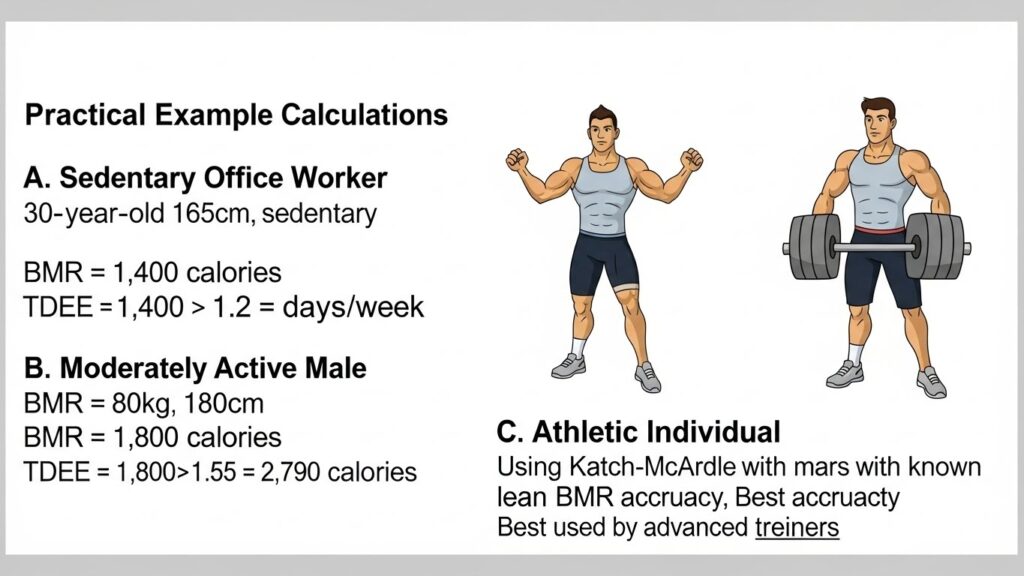
A. Sedentary Office Worker
A 30-year-old female, 65kg, 165cm, sedentary.
BMR ≈ 1,400 calories.
TDEE = 1,400 × 1.2 = 1,680 calories.
B. Moderately Active Male
A 25-year-old male, 80kg, 180cm, active 4 days/week.
BMR ≈ 1,800 calories.
TDEE = 1,800 × 1.55 = 2,790 calories.
C. Athletic Individual
Using Katch-McArdle with known lean mass.
Lean mass increases BMR accuracy.
Best used by advanced trainees.
How to Use Your TDEE for Different Goals
A. TDEE for Weight Loss
Create a calorie deficit of 300–500 calories.
That’s about 10–20% below TDEE.
This supports steady fat loss without burnout.
Safe fat loss is 0.5–1 kg per week.
Bigger deficits increase muscle loss.
Consistency wins long-term.
B. Muscle Gain / Bulking
Add 200–500 calories above TDEE.
Lean bulks reduce fat gain.
Aggressive bulks increase scale weight faster.
Protein intake is essential here.
Training quality matters as much as calories.
More isn’t always better.
C. Maintenance
Eating at TDEE keeps your weight stable.
Great for recomposition goals.
Small body changes still happen over time.
Factors That Affect TDEE Accuracy
A. Individual Differences
Metabolism varies between people.
Muscle burns more calories than fat.
Age and gender influence energy needs.
B. Lifestyle Factors
Sleep, stress, and hormones impact calorie burn.
Medications can change metabolism.
Health conditions affect accuracy.
C. Accuracy Limits
Activity multipliers are estimates.
NEAT changes daily.
TDEE is a starting point, not a fixed rule.
Tracking and Adjusting Your TDEE
A. Monitoring Progress
Track weight weekly, not daily.
Use measurements and photos.
Monitor energy and workout performance.
B. When to Adjust
Wait 2–4 weeks before changing calories.
Adjust by 100–200 calories only.
Small changes are more sustainable.
C. Adaptive Thermogenesis
Long dieting lowers calorie burn.
This is metabolic adaptation.
Diet breaks can help reset metabolism.
Online TDEE Calculators vs Manual Calculation
A. Benefits of Calculators
A calorie calculator saves time.
Reduces math errors.
Offers quick adjustments.
B. Understanding the Math
Knowing the TDEE formula builds confidence.
You can verify results.
This helps long-term success.
C. Recommended Tools
Reliable online TDEE calculators
Fitness apps with tracking features
Simple spreadsheets for consistency
Common TDEE Calculation Mistakes
A. Overestimating Activity
This is the most common error.
Most people choose too high.
It leads to stalled progress.
B. Not Recalculating
TDEE changes as weight changes.
Recalculate every few weeks.
Especially after plateaus.
C. Poor Food Tracking
Calories only work if tracked honestly.
Hidden calories add up fast.
Accuracy drives results.
Advanced TDEE Considerations
A. Athletes
Athletes need precise calorie control.
TDEE changes with training phases.
Periodization improves results.
B. Special Populations
Pregnancy, aging, and medical conditions change needs.
Always adjust carefully.
Professional guidance is recommended.
C. Macros After TDEE
Protein protects muscle.
Fats support hormones.
Carbs fuel performance.
Conclusion
TDEE calculation turns nutrition into a science, not a guess.
The core formula is simple: BMR × Activity Multiplier.
Everything else builds from this number.
Track progress, stay patient, and adjust when needed.
Your body gives feedback — listen to it.
Calculate your TDEE today and start optimizing your nutrition.