If you’ve ever tried to lose weight through calorie counting, you’ve probably come across two numbers: BMR and TDEE. They look similar, they sound related — but they’re not the same thing. And if you’re using the wrong one to plan your diet, you could be eating too little, too much, or just spinning your wheels without results.
In this guide, we’ll break down BMR vs TDEE in plain English, explain what each number means, and — most importantly — tell you which one you should actually be using to lose weight effectively.
Table of Contents
What Is BMR (Basal Metabolic Rate)?
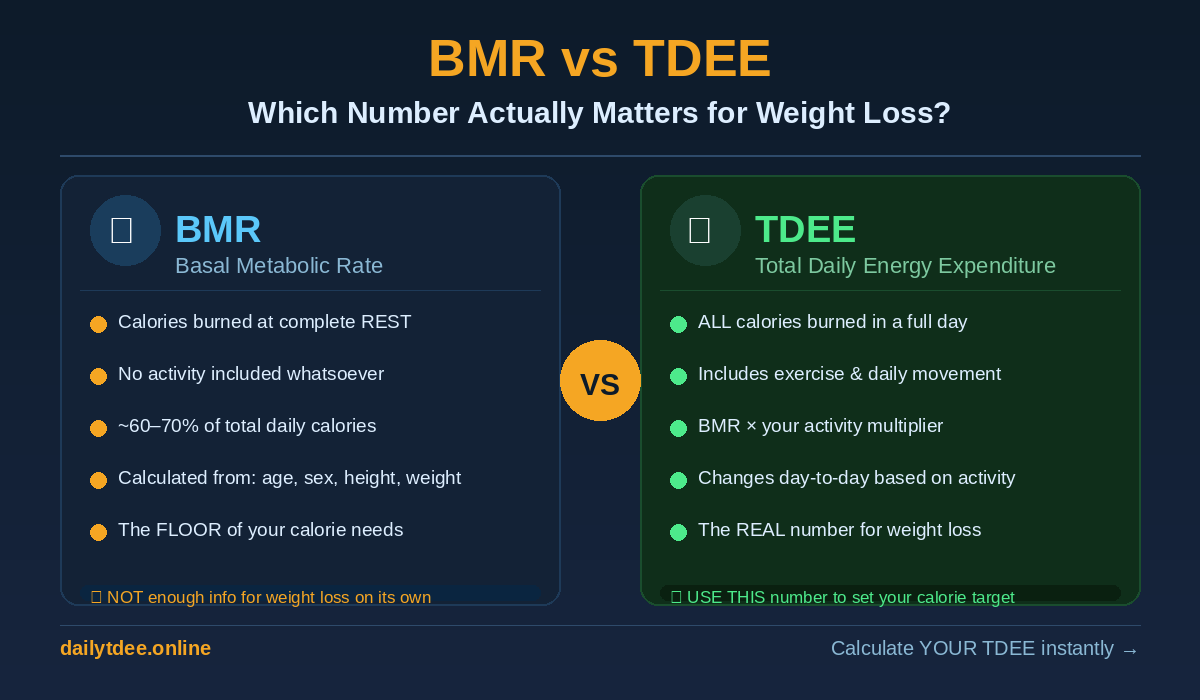
BMR stands for Basal Metabolic Rate. It’s the number of calories your body needs to perform its most basic functions — breathing, blood circulation, cell production, and keeping your organs alive — while at complete rest.
Think of BMR as the calories your body would burn if you stayed in bed all day without moving a single muscle.
How Is BMR Calculated?
BMR is calculated using formulas that take into account your:
Age
Sex
Height
Weight
The most widely used formula is the Mifflin-St Jeor equation:
Men: BMR = (10 × weight in kg) + (6.25 × height in cm) − (5 × age) + 5
Women: BMR = (10 × weight in kg) + (6.25 × height in cm) − (5 × age) − 161
What Does BMR Tell You?
BMR gives you your body’s minimum calorie floor — the absolute baseline your body needs just to survive. Eating below your BMR consistently is dangerous and can lead to muscle loss, nutrient deficiencies, and metabolic slowdown.
What Is TDEE (Total Daily Energy Expenditure)?
TDEE stands for Total Daily Energy Expenditure. It’s the total number of calories you burn in a day — including your BMR plus all the energy you expend through physical activity, digestion, and daily movement.
TDEE is the number that reflects your real life — not the theoretical version of you lying perfectly still in a hospital bed.
What’s Included in TDEE?
TDEE is made up of four components:
BMR — your baseline calorie burn at rest
TEF (Thermic Effect of Food) — calories burned digesting and processing food (~10% of total intake)
NEAT (Non-Exercise Activity Thermogenesis) — calories burned through daily movement like walking, fidgeting, and chores
EAT (Exercise Activity Thermogenesis) — calories burned during intentional workouts
How Is TDEE Calculated?
TDEE is calculated by multiplying your BMR by an activity multiplier:
Activity Level
Multiplier
Sedentary (little/no exercise)
BMR × 1.2
Lightly active (1–3 days/week)
BMR × 1.375
Moderately active (3–5 days/week)
BMR × 1.55
Very active (6–7 days/week)
BMR × 1.725
Extra active (athlete/physical job)
BMR × 1.9
BMR vs TDEE: Key Differences at a Glance
Feature
BMR
TDEE
What it measures
Calories at complete rest
Total daily calorie burn
Includes activity?
No
Yes
Used for weight loss?
No (too low)
Yes — this is your baseline
Reflects real life?
No
Yes
Risk of eating at this level
Nutrient deficiency, muscle loss
Maintenance (no weight change)
Which Number Actually Matters for Weight Loss?
Here’s the bottom line: TDEE is the number that matters for weight loss.
BMR tells you the minimum your body needs to survive. TDEE tells you the total your body actually burns. To lose weight, you need to create a calorie deficit below your TDEE — not below your BMR.
Why You Should Never Diet Below Your BMR
Eating below your BMR might seem like it would accelerate weight loss, but it almost always backfires:
Your body enters “starvation mode” and slows metabolism
You lose muscle mass instead of fat
Energy levels crash, making exercise harder
Nutrient deficiencies develop over time
Weight loss plateaus and rebounds become common
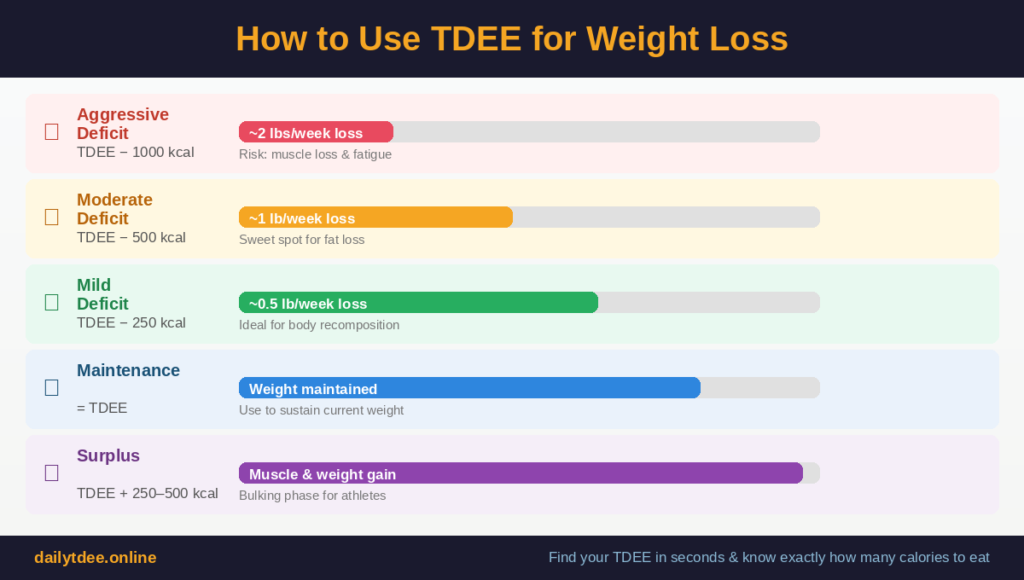
The Right Approach: TDEE-Based Calorie Deficit
The gold standard for sustainable weight loss is:
Calorie intake = TDEE − 300 to 500 calories per day
This creates a moderate deficit that burns fat steadily (roughly 0.3–0.5 kg per week) without triggering metabolic adaptation or muscle loss.
Example: If your TDEE is 2,400 calories/day, eat 1,900–2,100 calories to lose weight gradually and sustainably.
How to Use BMR and TDEE Together
While TDEE is the actionable number for weight loss, BMR still plays an important supporting role:
BMR sets your floor — never eat fewer calories than your BMR consistently
TDEE sets your ceiling for maintenance — eating at TDEE means zero weight change
Your deficit zone lives between BMR and TDEE — ideally 300–500 calories below TDEE
Use this framework:
BMR → Survival baseline (do not go below)
TDEE → Maintenance level (eat here to stay the same)
TDEE - 300/500 kcal → Weight loss zone (eat here to lose fat)
Does TDEE Change Over Time?
Yes — and this is one of the most important things to understand about long-term weight loss.
As you lose weight, your BMR decreases because you have less body mass to maintain. That means your TDEE also drops. This is why many people hit a weight loss plateau after several weeks — their TDEE has shifted, but they haven’t adjusted their calorie intake.
Pro tip: Recalculate your TDEE every 4–6 weeks or whenever you’ve lost 5+ kg to stay on track.
How to Calculate Your TDEE Accurately
The fastest and most accurate way to find your TDEE is to use a TDEE calculator. A good calculator will ask for your age, sex, height, weight, and activity level — then instantly give you your personalized maintenance calories and weight loss targets.
1. Is BMR the same as resting metabolic rate (RMR)?
Not exactly. BMR is measured under very strict conditions (complete rest, fasted state, neutral temperature). RMR is slightly less strict and typically 10–20% higher than BMR. For practical purposes, most calculators use RMR-style estimates and label them as BMR.
2. Can I lose weight eating at my BMR?
Technically yes, but it’s not recommended. Eating at your BMR means severely undereating for most people, which can cause muscle loss, nutrient deficiencies, and hormonal disruption. Always aim for a deficit from TDEE, not BMR.
3. What’s a safe calorie deficit for weight loss?
A deficit of 300–500 calories below your TDEE is considered safe and sustainable for most people. This leads to roughly 0.3–0.5 kg of fat loss per week. Larger deficits (500–750 kcal) may be appropriate for those with higher body fat percentages under professional guidance.
4. Does exercise change your TDEE?
Yes. More exercise means a higher activity multiplier, which raises your TDEE. This is why increasing physical activity is one of the most effective ways to create a larger calorie deficit without eating less.
5. Should I eat back calories burned from exercise?
This depends on how your TDEE was calculated. If you used a sedentary multiplier but then exercise frequently, you may need to eat back some of those calories. If your TDEE already accounts for your exercise level, you generally shouldn’t need to.
Conclusion
Both BMR and TDEE are valuable numbers — but they serve different purposes. BMR is your body’s minimum survival requirement. TDEE is your real-world total burn. For weight loss, TDEE is the number you need to work with.
Create a moderate deficit below your TDEE, never eat below your BMR, and recalculate every few weeks as your weight changes. That’s the framework for sustainable, science-backed fat loss.